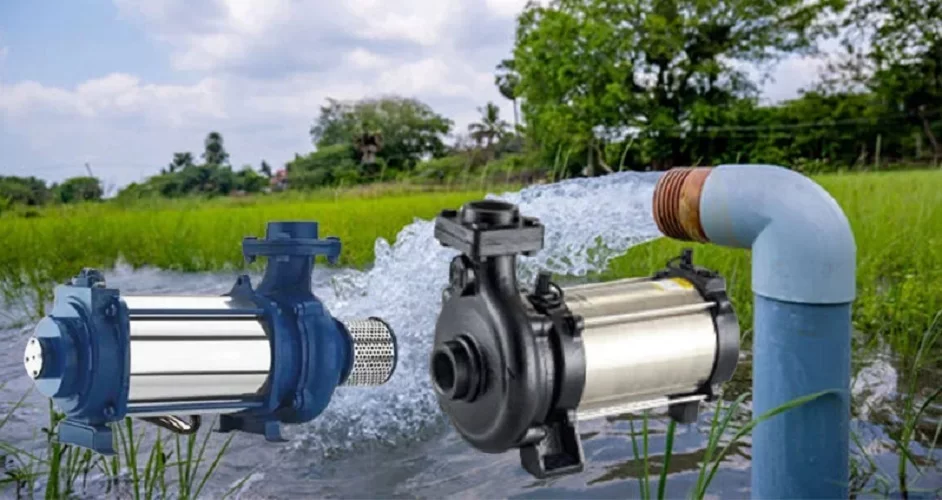
| Description | A pump which is coupled with a sealed motor and submerged inside a fluid. This then pumps the fluid, pushing it against gravity. | Reciprocating compressors consist of a cylinder with a piston in which the exhaust stroke causes a suction port to open. This then draws fluid into the cylinder and the suction stroke pushes the fluid into the discharge port. |
|---|
| Working principle | Fluid accelerated by the impeller loses it's their kinetic energy in the diffuser. This then causes a conversion of kinetic energy to pressure energy to take place. | Converts power from an electric motor into potential energy and stores this in the form of pressurised air. This is kept in a tank that pumps the fluid from the source. |
|---|
| Space | No separate space required to keep the assembly. | Significant space is occupied based on the capacity. |
|---|
| Applications | - Agriculture
- Apartments
- Industries
| |
|---|
| Advantages | - Works well where there is a high head option.
- No priming is required.
- Quiet/ noise free.
| - Works well where there is an intermittent flow.
- Assembly can be kept at a distance from source.
- Wide range of rotational speed.
|
|---|
| Disadvantages | - Lower discharge than other pumps.
- Repair is time consuming.
- Possibility of dry run when there is less fluid (e.g. during summer).
- Sand can enter from the water source.
| - Operation can be noisy and cause significant vibration.
- Assembly gets heated during the operation.
- High power consumption.
- Less efficient than other pumps.
|
|---|